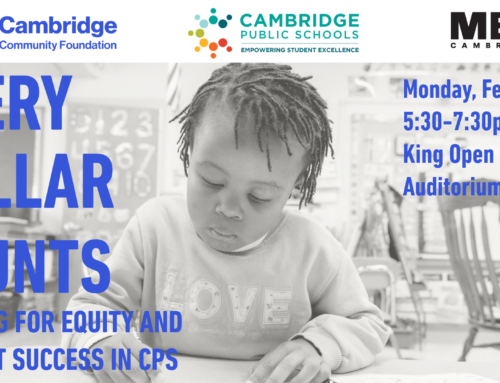
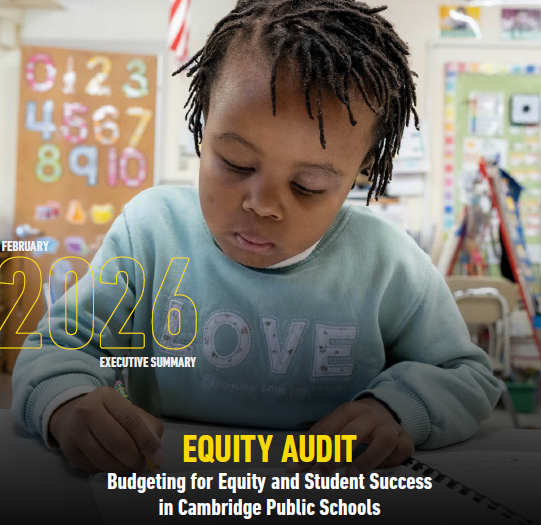
February 10, 2026 | Cambridge, Massachusetts — The Cambridge Community Foundation and Cambridge Public Schools have released an innovative, two-phased equity audit report, Budgeting for Equity and Student Success in Cambridge Public Schools, that provides specific recommendations for the district and its schools to address entrenched achievement and opportunity gaps.
The report, stemming from a two-part audit conducted in 2023 and 2024, finds that overall the Cambridge Public School district (CPS) meets or exceeds state benchmarks in nearly every school. But for decades, achievement and opportunity gaps have persisted among low-income students, English learners, students with disabilities, and students of color, across all grade levels. According to the most recently available state assessment data, in 2025, 28 percent of Black students met or exceeded MCAS expectations in ELA (grades 3-8), compared with 42 percent of Latinx students followed by 67 percent of Asian and 77 percent of white students. This pattern continues in high school, leading to discrepancies in college and career readiness. But with per-student spending of almost $40,000 per year—the sixth highest in Massachusetts—the question has always been why, and what are the barriers to equitable outcomes for all students?
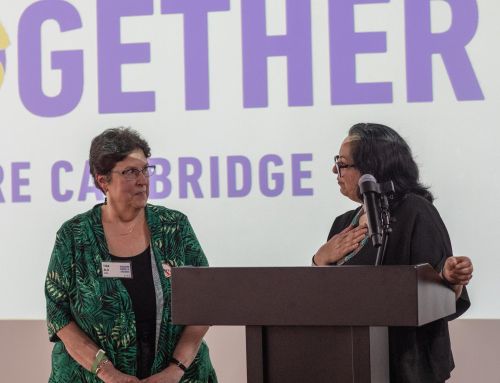
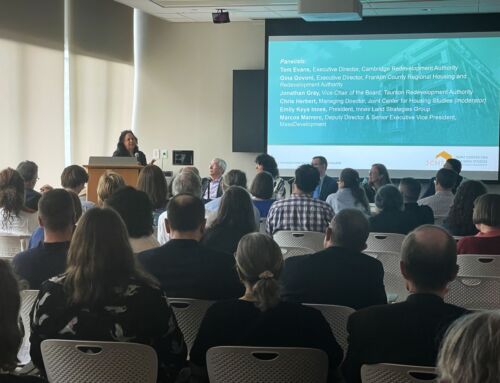
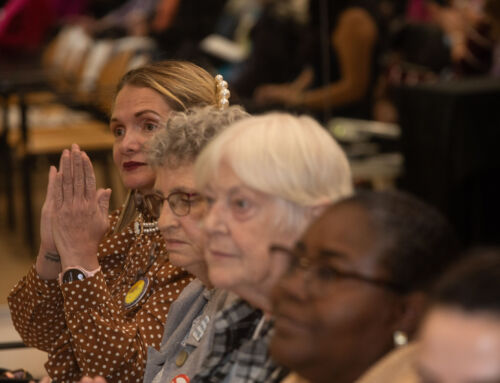
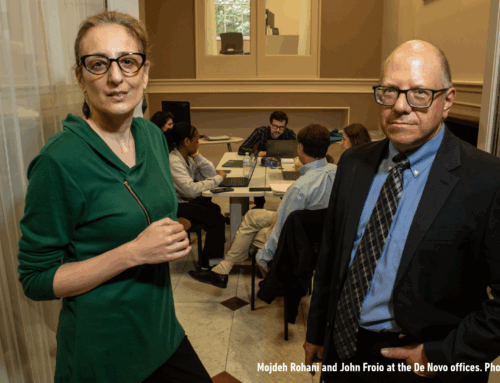
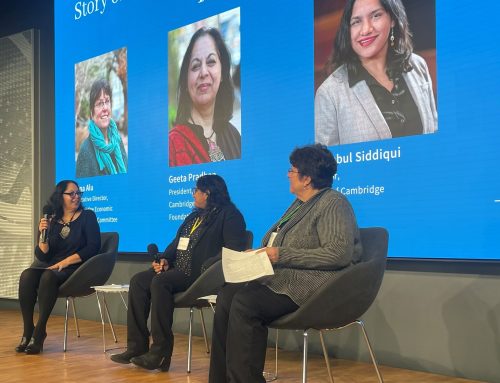
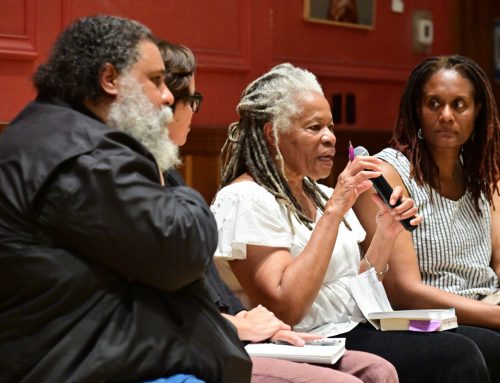
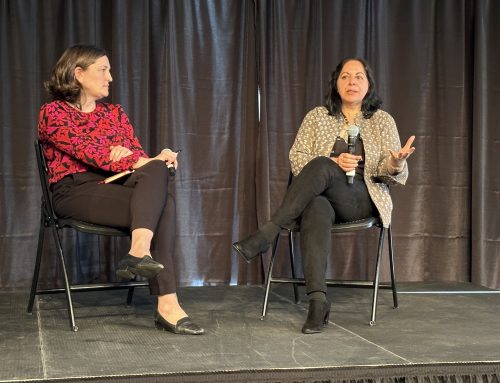
The equity audit, released February 9, 2026 at a public forum featuring state and local education experts, is helping answer that question. It was funded by the Cambridge Community Foundation (CCF) and undertaken in partnership with CPS and THRIVE!, a social enterprise headquartered in Washington, D.C., that uses technology to promote equity in spending. Three years in the making, the report uses publicly available data, internal surveys and observation at budgeting meetings to analyze factors contributing to the problem and offers recommendations for alleviating it in a manner consistent with established national best practices.
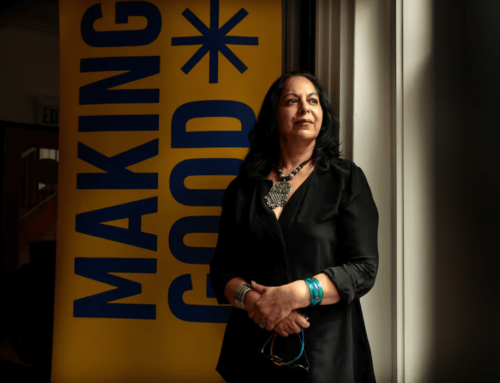
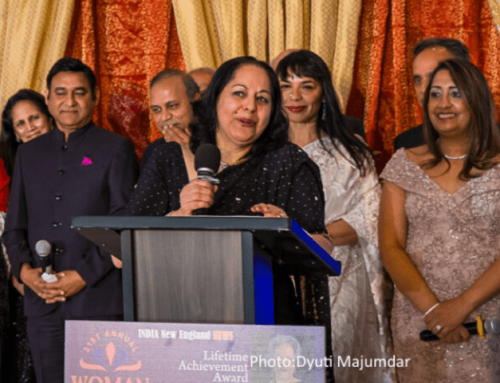
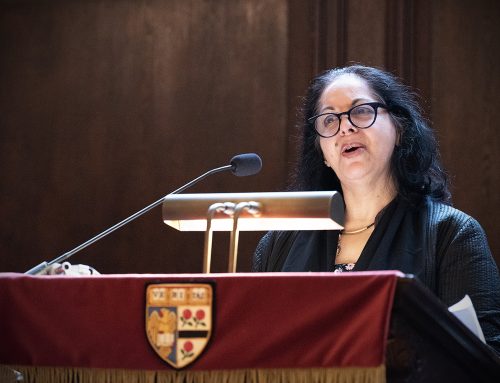
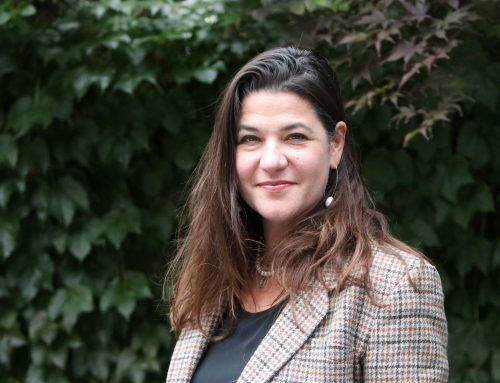
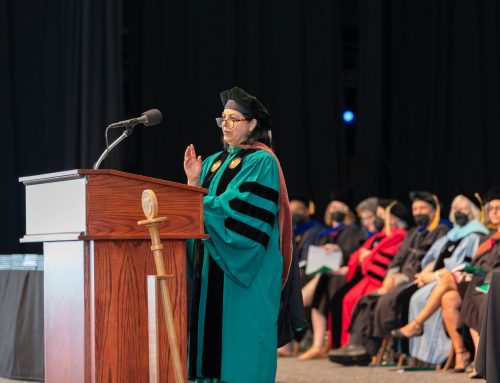
"Over the years so many programs and initiatives have been started by various constituencies," says CCF president Geeta Pradhan, "but not everyone has benefited from them. Public schools are supposed to ensure that all students, regardless of race or income, have a chance to meet their full potential. If there's a group that isn't being served well generation after generation, then clearly, we are not fulfilling that mission."
The report's executive summary presents key findings and provides context.
Phase I of the report examines resource allocation, human capital, formal partnerships, and institutional practices in CPS's central office. It lifts up the important role the central office can play in implementing changes that lead to measurable outcomes for every learner, academically, socially, and emotionally. This includes aligning leadership around the district plan, equipping staff with evidence-based tools, using disaggregated data systems, and investing for impact through outcome-linked decisions and stronger school-based community feedback loops.
In Phase II, THRIVE! analyzed each of CPS's 17 schools and created individualized guides for each (available at https://cambridgecf.org/equity-audit). Phase II of the report highlights that CPS has considerable strengths—including highly skilled district- and school-level staff and educators, a robust budget and ample resources, and an established equity infrastructure and systemwide supports. It recommends three equity levers as being key to achieving equitable outcomes for all students:
- Implementing evidence-based programs with fidelity—that is, exactly as they were designed and carefully monitoring their outcomes using disaggregated data systems that adjust in real time.
- Operationalizing the Multi-tiered System of Supports CPS currently uses as recommended by the Massachusetts Department of Elementary and Secondary Education. This system ensures that all students receive the right help at the right time: Tier 1 (for all), Tier 2 (targeted), Tier 3 (intensive), guided by data on entry, progress, and exit.
- Combating chronic absenteeism, which disproportionately harms the most disadvantaged students and widens achievement gaps, with a robust, evidence-based intervention plan across all three tiers, addressing school climate, targeted mentoring, and family engagement and implementing intensive supports for the highest-need students.
The timing for a sustained effort to address these inequities is ideal, with a new superintendent, a new four-year district plan in the works, and the Commonwealth's removal of the MCAS as a graduation standard.
CPS has already undertaken several steps that align with the report's key recommendations, but, says Superintendent David Murphy, "This analysis will help advance the work our team is doing to ensure the Cambridge Public Schools is positioned to fulfill the vision of a public school system in which all students – regardless of background or need – have the chance to pursue a post-secondary life defined by opportunity, fulfillment, and happiness."
CONTACTS:
Lauren Marshall, Cambridge Community Foundation
(617) 872-6543 (cell)
Jackie Piques, Cambridge Public Schools
(857) 331-4957 (cell)